 For years I've been telling people that two members of my graduate committee betrayed me in their letters of recommendation. But last week I pulled those letters out of a manilla file folder titled "Absolutely Illegal Information" and discovered that my perception of them has changed. My work as a faculstrator and a member of several hiring committees helps me to see these letters in a new way.
But first I should say something about the title of the file where I've kept these letters. It has to do with the fact that when I asked the University of Utah placement service to create a packet for me, I signed a form agreeing that the letters would be confidential. So why do I have copies? Well, during my 1988 job search I kept getting these form letter rejections. My running buddy, Professor Fox, asked me one day how the search was going and I told him about the regular rebuffs. He suggested that I should violate my agreement with the placement service and have my letters sent to a friend. He said that he'd known someone who had found out that he'd been screwed over by the letter writers. When I questioned him about the ethics of violating my agreement, he made his usual argument that the system was rigged and that when one is a graduate student in a powerless situation it's not a violation of ethics to find out what stumbling blocks have been put in one's way by those who have far more power in the situation. I, of course, accepted his way of seeing the situation. We shared the vision that "one doesn't owe truth to power."
So I had the packet sent to a friend and I read the letters. At the time I read them, I perceived certain comments as left handed compliments that were shaded to present me as someone who would not actually be a good scholar/researcher. But now I see them as accurate assessments of my goals, interests, and skills.
For example: "First of all, Karen Huck is a committed and highly-motivated teacher and citizen. I say this not to slight her intellectual capabilities and accomplishments -- which are fine -- but because I have rarely seen a graduate student (or colleague) so devoted to the possibilities and responsibilities of public education. I had prior to her written and oral qualifying exams thought of her as a critic/rhetorician whose interest in advanced theory and in what is often described as nontraditional subject matter made her a challenging 'young turk.' What is now apparent to me, however, is that her interest in such work, while not superficial, is actually in the service of traditional ideas toward the profession."
I've highlighted the sections that led my younger self to feel as though my qualifications were being undercut.
This same writer went on to mention my "improved writing style" he said that I seem to be growing out of "what I consider her only area in need of improvement, which is a tendency to think in dualistic terms and thus neglect to consider the qualifications and refinements present in any body of material."
Well, this was honest. Yet it still bugged me when I read it.
The other male letter writer said, "However, research is not her strongest attribute or interest." And really, for 25 years that's all I remembered about his letter. As I reread the letters last week I noticed that the paragraph above that sentence ended with this sentence: "Karen is a bright and creative thinker who will be successful and a publishing scholar." And in the paragraph that followed his denigration of my research abilities he wrote, "Most of all she is a dedicated teacher. She has been successful in our most demanding courses, those with the greatest student anxiety because they are screening courses for admission to the major. She receives strong student ratings even though she sets high standards." He also mentions that I have provided lots of service to the department and "She is always one of the first to volunteer. . . . She deserves serious consideration, particularly in an institution with a strong commitment to teaching."
Of course, I also have a new view of the two letters I considered highly positive, both by female faculty. I now see that one of them ends with a sentence that at this point in time seems to be the sort of thing that could be said about any communication teacher -- but with fancy words. She recommends me "not as the paradigm of the academic ideal, but as an indicator of a new kind of communication professional: one who substantiates her restless interest in social influence and change with an unbending commitment to understanding the power of discourse." This means that I care about persuasion because I'm committed to caring about persuasion. Sigh.
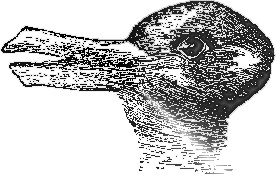
It was fitting that I reread these letters last week when my online interpersonal communication class was covering the concept of perception. Perception is variable and subject to influence from our past and present experiences. When I first read those letters I was looking for betrayal and I found it. Now I'm looking through the eyes of two ad a half decades of being a teacher, community members, and occasional researcher and seeing that the writers weren't trying to hurt me but help me.
(The illustration at the top of the page is the world famous "duck-rabbit.")
